|
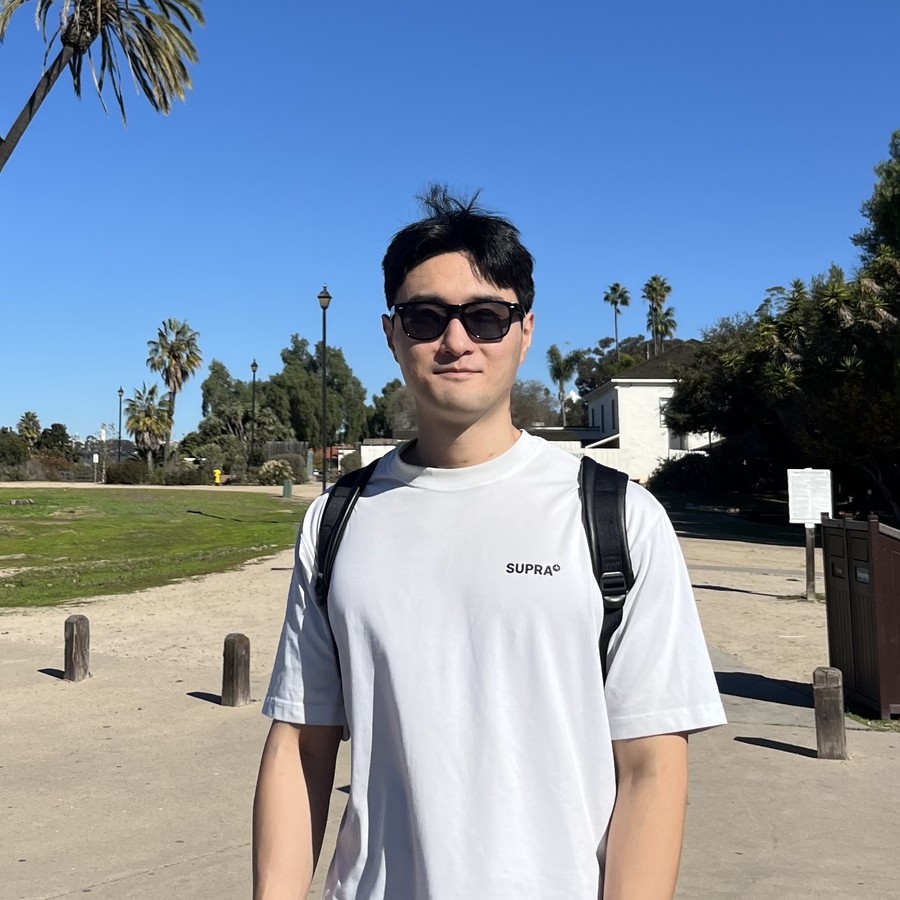
Hanbum Ko I am a Ph.D. student in Artificial Intelligence at Korea University, advised by Prof. Sungwoong Kim and Prof. Sungbin Lim, as a member of the AGI Laboratory, and I received my M.S. in Artificial Intelligence from UNIST. My research is on AI for Science — building large language models that reason about chemistry, ground themselves in molecular structure, and can be trusted on real scientific tasks. |
|
Updates
|
ResearchMy research is on AI for Science, primarily large language models for chemistry. Three lines of work: eliciting explicit reasoning for retrosynthesis and reaction prediction; grounding multimodal LLMs in molecular structure so that molecular graphs are used rather than ignored; and building the data pipelines and benchmarks needed to train and evaluate these models on realistic tasks. I also work on neural combinatorial optimization for industrial problems such as circuit routing and truck-and-drone delivery. In both areas I work on settings with real-world constraints — feasible solutions that are hard to find, semi-structured data, and evaluation that reflects how a model would actually be used. First-author works are highlighted below. |
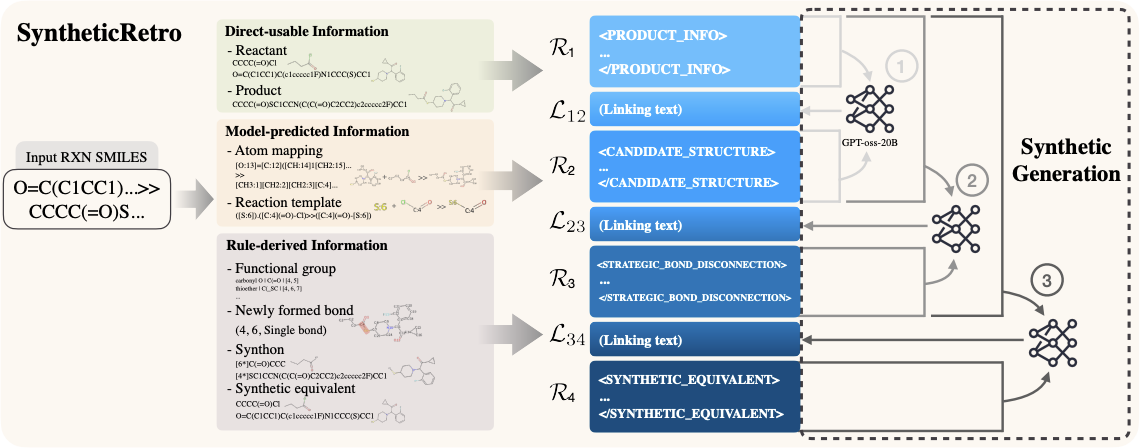 |
RetroReasoner: A Reasoning LLM for Strategic Retrosynthesis Prediction
Hanbum Ko, Chanhui Lee, Ye Rin Kim, Rodrigo S. Hormazabal, Sehui Han, Sungbin Lim, Sungwoong Kim Findings of EMNLP, 2026 paper Trains an LLM to reason explicitly about strategic bond disconnections — which bond to break, and why — before proposing precursors, so a retrosynthesis prediction can be inspected rather than merely ranked. |
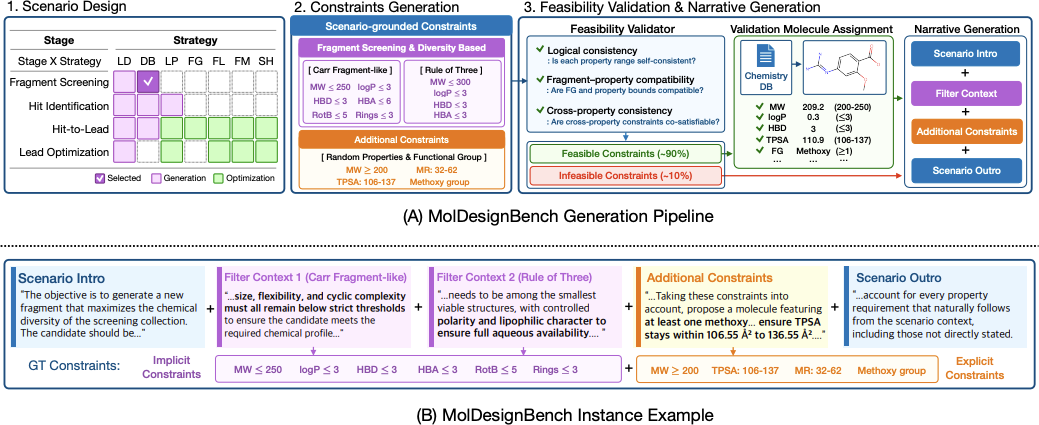 |
MolDesignBench: Evaluating LLM-based Agent for Scenario-grounded Molecular Design
Yongjun Jeong, Hanbum Ko, Ye Rin Kim, Chanhui Lee, Rodrigo S. Hormazabal, Jaewan Lee, Sehui Han, Sungbin Lim, Sungwoong Kim Conference on Language Modeling (COLM), 2026 A benchmark that places LLM agents in scenario-grounded design tasks — an objective and its constraints — and measures whether the molecules they propose actually satisfy them. |
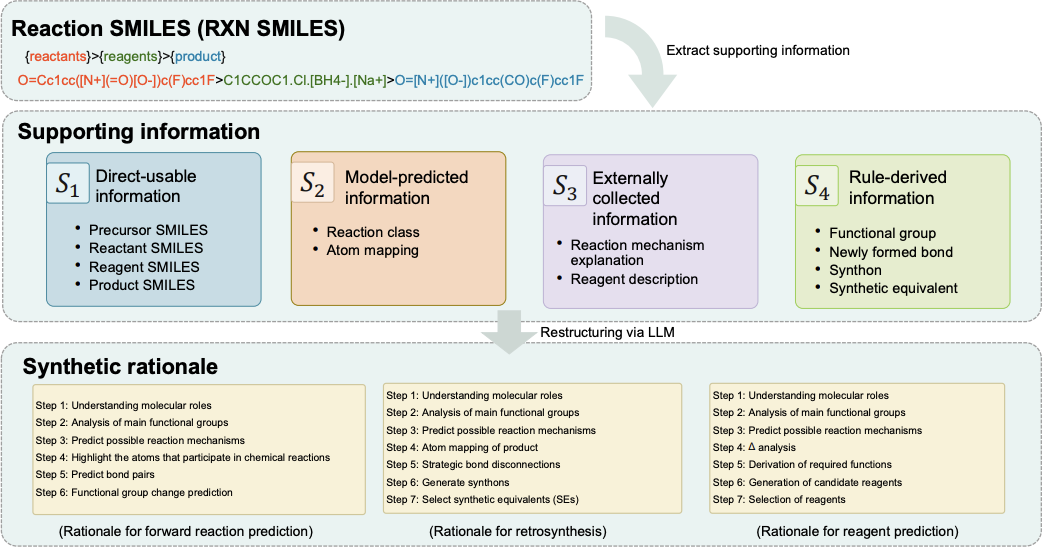 |
ReactionReasoner: Towards Reasoning LLM for Chemical Reaction Prediction
Hanbum Ko, Chanhui Lee, Ye Rin Kim, Rodrigo S. Hormazabal, Sehui Han, Sungbin Lim, Sungwoong Kim NeurIPS Workshop on AI for Science, 2025 paper Rather than mapping reactants to products in a single pass, the model works through the transformation step by step, which helps most where pattern matching over SMILES fails. |
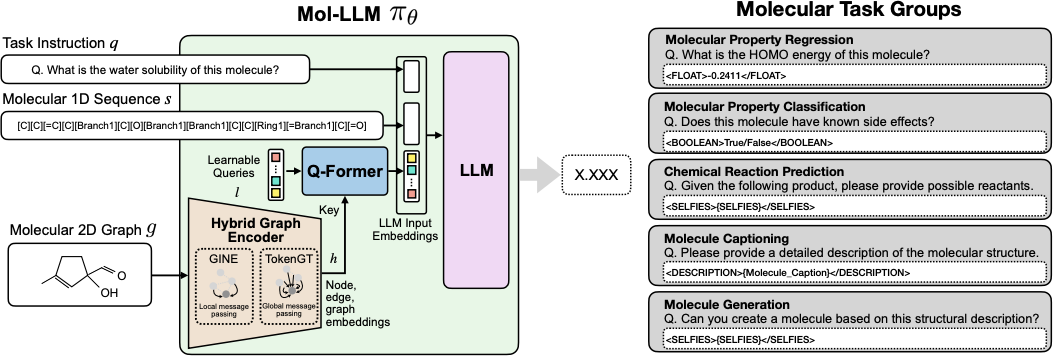 |
Mol-LLM: Multimodal Generalist Molecular LLM with Improved Graph Utilization
Chanhui Lee, Hanbum Ko, Yuheon Song, Yongjun Jeong, Rodrigo S. Hormazabal, Sehui Han, Kyunghoon Bae, Sungbin Lim, Sungwoong Kim NeurIPS Workshop on AI for Science, 2025 arXiv / openreview Multimodal molecular LLMs are given molecular graphs but rarely use them. Molecular structure Preference Optimization (MolPO) optimizes preferences between correct and perturbed structures, so the model exploits structure and outperforms both generalist and specialist models on property and reaction prediction. |
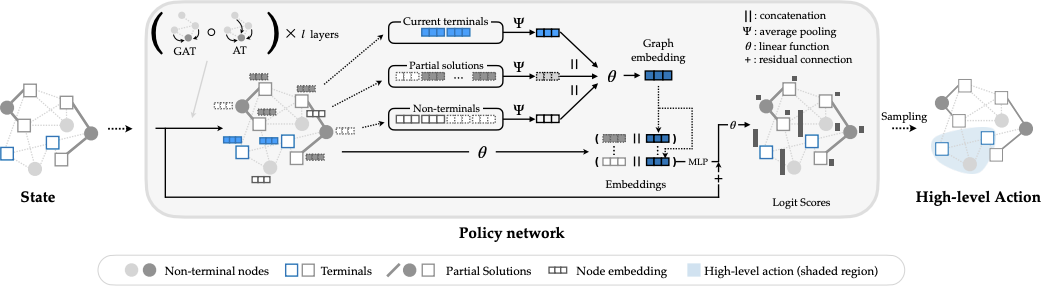 |
Hierarchical Decomposition Framework for Steiner Tree Packing Problem
Hanbum Ko, Minu Kim, Honglak Lee, Sungbin Lim, Sungryull Sohn, et al. ICML Workshop on Sampling and Optimization in Discrete Space (SODS), 2023 / ICORES, 2025 (Best Paper Award) paper / ICORES version Rectilinear Steiner tree packing, the problem behind circuit routing, is hard even to find a feasible solution for. Our hierarchical optimizer decomposes it into high- and low-level sub-problems with far smaller search spaces, then composes their solutions. |
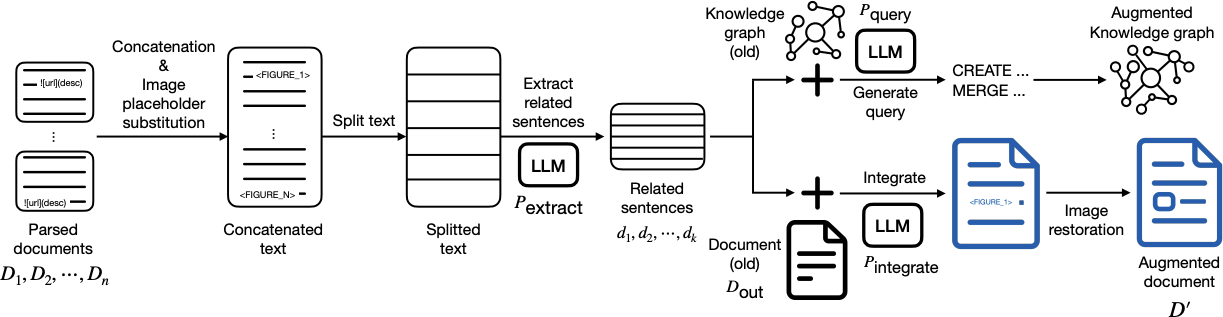 |
Filling in the Gaps: LLM-Based Structured Data Generation from Semi-Structured Scientific Data
Hanbum Ko, Hongjun Yang, Sehui Han, Sungwoong Kim, Sungbin Lim, Kyunghoon Bae, Rodrigo S. Hormazabal ICML Workshop on AI for Science, 2024 paper / talk A framework for gathering, augmenting, and restructuring unstructured scientific documents with LLMs, applied to chemical reactions for document augmentation and knowledge-graph completion. |
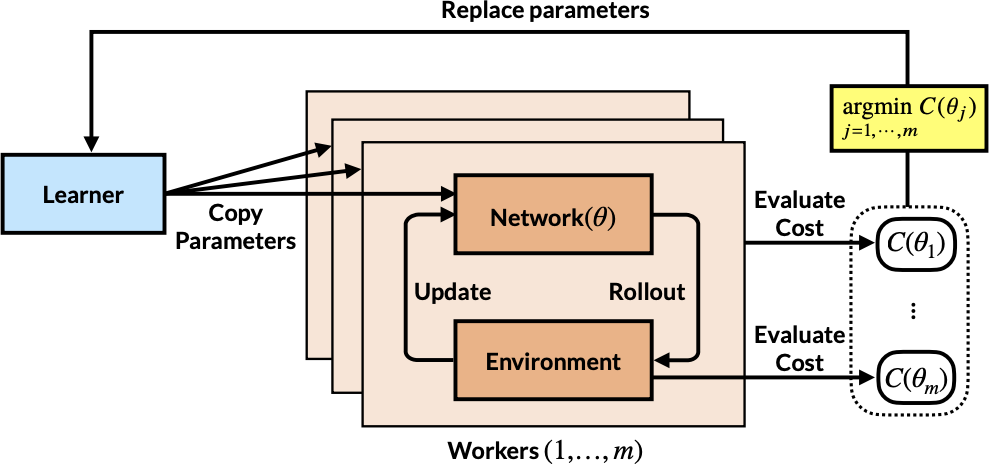 |
A Deep Reinforcement Learning Approach for Solving the Traveling Salesman Problem with Drone
Aigerim Bogyrbayeva, Taehyun Yoon, Hanbum Ko, Sungbin Lim, Hyokun Yun, Changhyun Kwon Transportation Research Part C: Emerging Technologies, vol. 148, 2023 paper / journal / code A hybrid attention-encoder / LSTM-decoder model for routing a truck and a drone in tandem, improving both solution quality and computation time over purely attention-based models. |
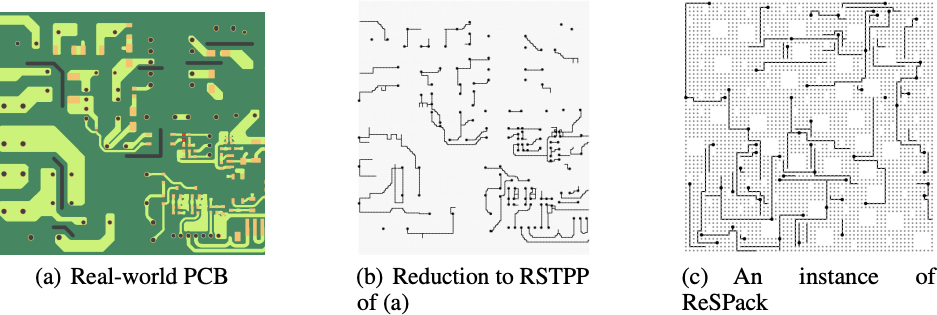 |
ReSPack: A Large-Scale Rectilinear Steiner Tree Packing Data Generator and Benchmark
Kanghoon Lee, Youngjoon Park, Han-Seul Jeong, Sunghoon Hong, Deunsol Yoon, Sungryull Sohn, Minu Kim, Hanbum Ko, et al. NeurIPS Workshop on SyntheticData4ML, 2022 paper A generator and benchmark producing rectilinear Steiner tree packing instances at scale, with controllable size and difficulty, for training and comparing learned routing solvers. |
|
SwarmSense: Effective and Resilient Drone Swarm and Search for Disaster Response and Management Application
Cheolmin Jeon, Jeongsoo Ha, Hanbum Ko, Byeongman Lee, Bo Ryu The World Congress on ANBRE, 2019 A drone-swarm sensing and search system for disaster response, resilient to the loss of individual drones. |
|
|
Augmenting Structure for Noise Reduction in UAV
Hanbum Ko, Yeeun Lee, Suyeon Jin, Emma Kang, Nick Noonan, Minsun Lee, Michael J. Hopmeier, Eric T. Matson The World Congress on ANBRE, 2019 Structural augmentations to a UAV airframe that reduce the noise it radiates in flight. |
Education
|
Experience
|
Selected Projects & Awards
|
|
Template borrowed from Jon Barron. |